You read a chapter. You highlight important sentences. You read it again. Then again. The night before the exam, you suddenly feel like you remember everything.
But when the question paper reaches your desk, something strange happens. You recognize the topic. You remember seeing the answer. But you can't actually recall it.
This is one of the biggest problems with traditional studying. Recognizing information is not the same as remembering it.
This is why techniques such as active recall and spaced repetition have become increasingly popular among students looking for more effective ways to study.
Instead of repeatedly exposing yourself to information, these techniques encourage your brain to actively retrieve information and revisit it at strategically spaced intervals.
What Is Active Recall?
Active recall is a study technique where you deliberately try to retrieve information from memory instead of simply rereading it.
Imagine you just studied the definition of photosynthesis. A passive approach would be to read the definition three times. An active recall approach would be to close the book and explain photosynthesis from memory.
That small change makes your brain work harder — and that's the point.
Why Does Active Recall Feel Difficult?
Because you're actually trying to remember.
When you reread something, the information is right in front of you. It feels familiar. That familiarity can create the illusion that you know the material.
Active recall removes that support. You have to retrieve the information yourself.
For example, instead of reading that mitochondria are known as the powerhouse of the cell, ask yourself: 'What is the function of mitochondria?' Then answer without looking.
If you get it right, great. If you don't, you've discovered something that needs more study. That is useful information.
How to Use Active Recall for Studying
1. Question Yourself
Turn your notes into questions. Instead of writing 'Photosynthesis occurs in chloroplasts,' write 'Where does photosynthesis occur?' Then attempt to answer without looking.
2. Close the Book and Explain
After studying a topic, close your textbook. Then explain the topic aloud as if you were teaching someone else. If you get stuck, you've found a knowledge gap.
3. Use Flashcards
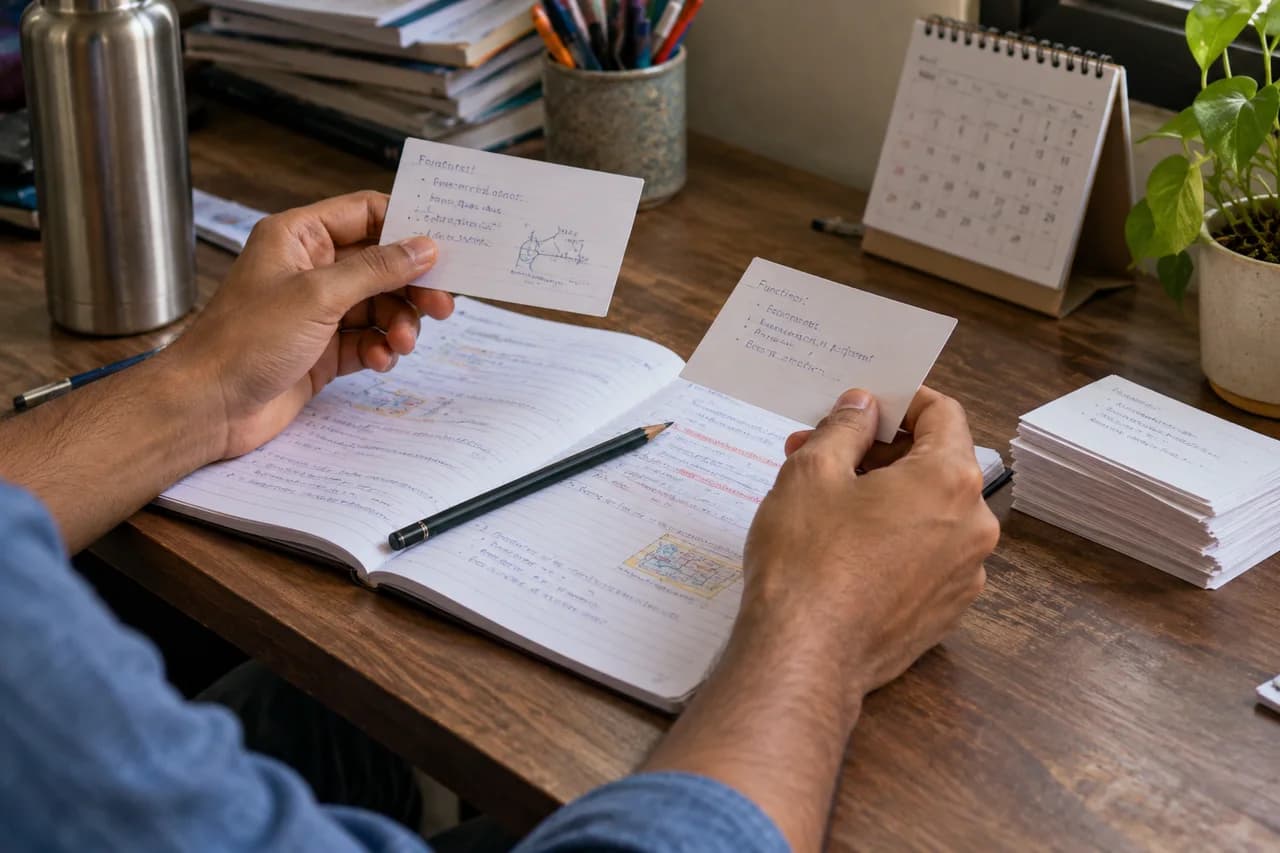
Flashcards are particularly useful for definitions, formulas, vocabulary and factual information. Try to answer before flipping the card.
4. Practice Questions
Past papers and practice questions are another form of active recall. Instead of simply reading how a question is solved, try solving it yourself.
What Is Spaced Repetition?
Spaced repetition is the practice of reviewing information at increasing intervals over time.
Instead of studying something once and forgetting it, you revisit it periodically. A simple example is Day 1, Day 2, Day 4, Day 7, Day 14 and Day 30.
The exact schedule doesn't need to be identical for everyone. The idea is that information should be reviewed before it completely disappears from memory.
Why Combine Active Recall and Spaced Repetition?
Active recall answers: 'Can I remember this?' Spaced repetition answers: 'When should I review it again?'
Together, they create a structured learning loop.
You learn a concept on Monday, test yourself Tuesday, revisit it several days later, identify what you struggle with, focus on that part and test yourself again later.
This is much more intentional than simply reading the chapter repeatedly.
A Simple Spaced Repetition Schedule for Students
- Day 1 — Learn the topic.
- Day 2 — Test yourself.
- Day 4 — Test yourself again.
- Day 7 — Review the topic.
- Day 14 — Test yourself.
- Day 30 — Do a final recall session.
If you forget something during a review, don't panic. That's exactly what the process is designed to identify.
What If I Forget the Answer?
Forgetting is not failure. In fact, forgetting can tell you exactly where your next study session should focus.
Suppose you're revising ten flashcards and remember eight. You forget two. Instead of rereading all ten equally, you can spend more time on the two difficult cards.
This makes your study sessions more efficient.
Active Recall for Different Subjects
- Mathematics — solve problems without looking at worked solutions.
- Science — explain processes and definitions from memory.
- History — create questions around dates, events, people and causes.
- Geography — draw maps or explain concepts without referring to your notes.
- Languages — recall vocabulary and construct sentences.
- Competitive exams — use timed practice questions and analyze mistakes.
The important thing is that you're retrieving information rather than merely consuming it.
Active Recall vs Rereading
One student reads a chapter three times, highlights important lines and looks over notes before sleeping. Another reads the chapter once, closes the book, writes down what they remember, checks their answers, creates questions and tests themselves later.
The second student is studying more actively.
The goal isn't to make studying exhausting. The goal is to make each study session more meaningful.
How Technology Can Help
Technology can make these techniques easier to organize. Students can use digital tools to create flashcards, practice questions, revision schedules, study plans and self-tests.
An AI-powered learning platform can also help students turn material into questions or practice activities.
For example, a student could study a chapter and then use a learning assistant to generate questions based on that topic. The student then attempts the questions without looking at the material.
This creates a simple active recall workflow.
Common Mistakes Students Make
- Looking at the answer too quickly — give yourself time to retrieve the information.
- Making flashcards too complicated — keep each card focused on one concept.
- Only studying what you already know — spend additional time on weak areas.
- Cramming everything before an exam — spaced repetition works best when started earlier.
- Confusing familiarity with mastery — recognizing an answer doesn't necessarily mean you can produce it independently.
How to Build a Daily Active Recall Routine
- Before studying — choose one topic.
- During studying — understand the material without worrying about memorizing every sentence immediately.
- After studying — close your notes and write down what you remember.
- Next day — test yourself again.
- End of the week — do a larger review.
- Before the exam — use practice questions and mock tests to identify remaining weak areas.
This approach turns studying into a continuous cycle rather than one massive session before the exam.
Can AI Help With Active Recall?
Yes — if used correctly.
Instead of asking AI for a summary, try asking it to create ten questions from a chapter and withhold the answers until you attempt them.
You can also ask it to quiz you one question at a time or give you a difficult question based on a concept.
This changes AI from a content generator into an interactive study partner.
For students using platforms such as CAPGENX Lexqo, this kind of workflow can make digital studying more structured and interactive.
Final Thoughts
The most effective study method isn't necessarily the one that makes you feel like you're studying the hardest. It's the one that helps you remember and apply what you've learned.
Active recall forces you to retrieve information. Spaced repetition gives you a framework for revisiting that information.
Together, they can turn studying from endless rereading into a more deliberate process.
So the next time you finish a chapter, don't immediately read it again. Close the book and ask yourself: 'What do I actually remember?' That question might be more valuable than another hour of rereading.